It is one of the most beloved beverages worldwide, but it doesn't taste the same in every glass. Discover how to enjoy it.
If you think there's nothing better than drinking a cold beer straight from the bottle... you're mistaken! To enhance its flavor, aroma, and color, and to ensure the right carbonation and foam, learn about the types of beer glasses that every good brewer should use.
Why drink beer from a glass?
When served in a glass, beer will lose carbon dioxide (CO2) more quickly than in a bottle; this will help you avoid the feeling of bloating, but more importantly, its aromas will volatilize, allowing you to better appreciate its qualities. The size of beer glasses and cups corresponds to the alcohol content of the beverage: those with low alcohol content are usually served in larger glasses, while beers with higher alcohol content are served in smaller glasses. Additionally, the shape of the glass helps maintain the head (foam).
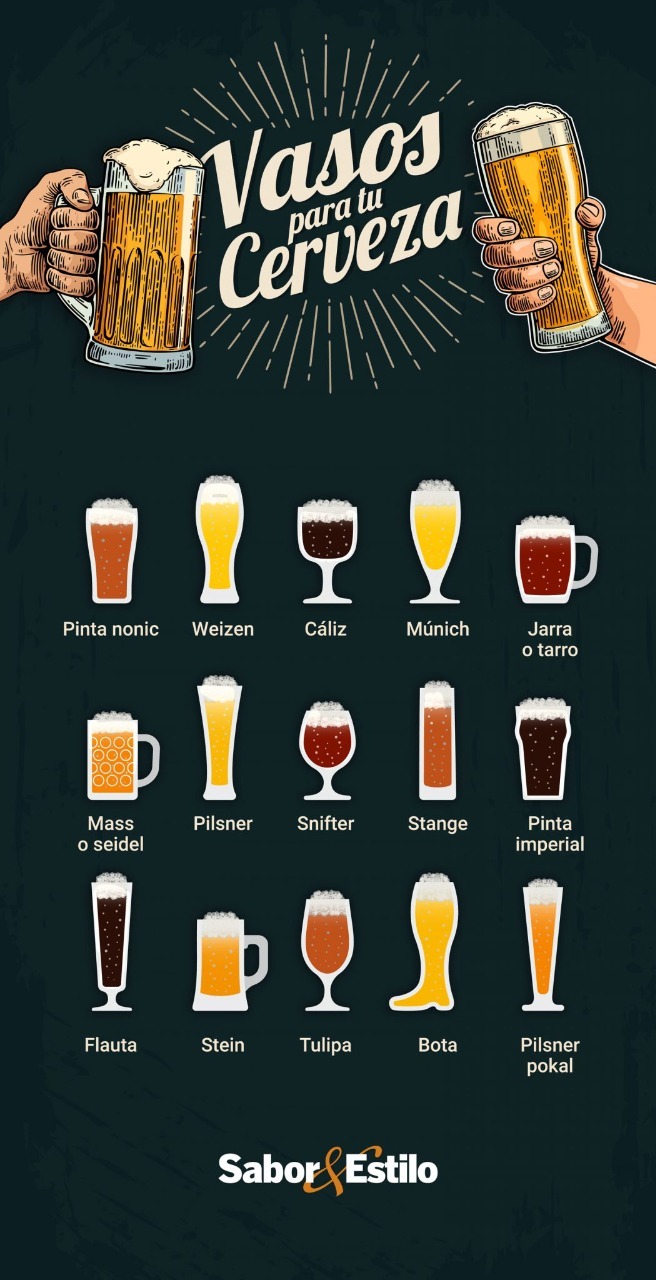
Nonic pint glass. With a capacity of 568 ml, it is the standard format in the UK. It is wider at the top, which promotes a creamy foam and allows for a better grip.
- Use it for ale, porter, or stout beers.
Weizen glass. Tall and wider at the top, with thin walls. It typically holds 200 ml of beverage and has space for abundant foam, as well as to maintain its aroma and color.
- Recommended for wheat beers (weizen in German) such as: wheat ale, hefeweizen, dunkelweizen, weizenbock, and kristalweizen.
Chalice glass. Also called goblet or chalice, it has a large capacity to maintain the head. Its wide mouth design favors large, abundant sips, and a wide stem to hold the beer without altering its temperature. Chalice glasses have thicker walls than goblet glasses.
- Recommended for strong dark beers like Belgian IPAs, strong dark ale, dubbel, tripel, and quad.
München glass. Its main function is to highlight the color and, by allowing the beer to contact the outside, retain both foam and the right carbonation.
- Designed for pilsner beers (also known as pils or pilsener, light and fresh).
Mug or stein. They can come in various sizes, but their main feature is the handle to hold them and prevent heat transfer from the hand to the beer. They are usually made of thick glass to provide greater durability and insulation.
- Recommended for German, American, English, Irish, and of course, Mexican beers of all types.
Mass or seidel. In German, maß means “one liter,” which is the capacity of this mug, characteristic of Oktoberfest. The seidel mug usually holds half a liter of beverage.
- Traditionally used to serve German ale and lager.
Pilsner glass. Its conical shape maintains the flavor and aroma of the hops, and it also retains the bubbles and allows you to enjoy the clarity of light beers. It typically holds 350 to 400 ml.
- Recommended for all types of lagers (like American, Vienna, or bock) and pilseners.
-
Snifter glass. Mainly used for aged spirits like cognac and brandy. Its capacity ranges from 180 to 240 ml. With a large volume in the body, its top narrows to capture and enhance the aromas of the beer.
- Recommended for high-alcohol beers such as: barleywines, imperial stout, eisbock, and barrel-aged beers.
-
Stange glass. In German, stange means post, referring to something narrow, straight, and cylindrical. It concentrates the aromas of hops and malt and maintains carbonation at appropriate levels.
- Recommended for fine beers like lambic, bock, kölsch, Czech pilsner, rye beer, gose, altbier, and rauchbier.
-
Imperial pint. Unlike the American nonic pint, it has a slight curve at the top that helps preserve the foam and its grip. It can hold 568 ml of beer.
- Ideal for ales and lagers like pale ale, IPA, amber, red ale, brown ale, milk stout, oatmeal stout, porter, and scotch ale.
-
Flute glass. With a narrow and elongated shape, very similar to a champagne glass, except that its stem is shorter. This shape allows the flavor of the beer to concentrate and release all its aromas quickly.
- Use it for lambic, gueuze, brut, weizenbock, wisbock, and fruity beers.
Stein. It differs from the classic mug by having a hinged lid and a lever to open it with the thumb, as well as being made of materials like ceramic and metal (although stein in German means “stone”). They can hold up to 1 liter of beverage.
- Currently, they are used more for decoration, although you can still serve lager, Vienna, München, or bock beers in them.
Tulip glass. It gets its name from resembling a tulip, a shape that maintains the head longer to better appreciate the malt and hop flavor.
- Perfect for full-bodied and aromatic beers, such as Scottish or Belgian ales, or for beers with strong flavors and high alcohol content.
Boot glass. Generally has a capacity of one and a half liters. Its shape comes from a legend in ancient Prussia (now Germany) where a general promised his soldiers to drink beer from his boot if they won a battle they thought was lost. After winning, he ordered a glass to be made in the shape of a boot so he wouldn't have to drink from his footwear.
- Types of beer like bock and märzenbier are suitable for drinking from this curious boot.
Pilsner pokal glass. Long and narrow, allowing light and golden beers to be better appreciated. The difference from the classic pilsner is that the pokal has a cup-like base.
- Used for pilsner and lager beers like bock, helles, and dunkel.
- Written by: Ingrid Díaz Source: Sabor y Estilo https://saboryestilo.com.mx/sommelier/tipos-vasos-cerveza/